
The river is already at work when the carriage starts to move. Terraces step down toward the Urubamba, the gorge closes in, and for the next hour and a half or two there is only one track between you and Machu Picchu Pueblo. The best train to Machu Picchu is the departure that sets you down in town before the hour printed on your citadel ticket, on a morning the line is actually running.
I'm Francisco. I design private journeys through Peru from Lima, and "which train?" is usually three questions: PeruRail or Inca Rail, which class, and whether to board in Cusco or in the Sacred Valley. This is how I answer them. Departures move. So do fares.
Before you lock a seat
Read the dated note I keep on this railway: https://travizperu.com/machu-picchu-train-status/. That page is what the Ollantaytambo–Aguas Calientes line is doing. This one is how to choose the train when it is running. If the two disagree, believe the status page. I update it from Lima.
PeruRail or Inca Rail
Two companies share the track. PeruRail and Inca Rail both carry passengers between the Sacred Valley and Aguas Calientes, the town also called Machu Picchu Pueblo. They arrive at the same station. A problem with one train can hold the other, because there is no second track to pass on. That is what happened near Pampacahua on 2 October 2026. I come back to that below, and the living account sits on the Machu Picchu train status page.
PeruRail has the widest spread of departures: the Expedition, the Vistadome, the Vistadome Observatory, and Hiram Bingham, a Belmond train. Inca Rail boards at Ollantaytambo, from The Voyager and The 360° up through The Prime, The First Class, and The Private. I do not keep a favorite logo. I keep a favorite hour. If the scenic car you wanted is full and the other company still has the departure that meets your ticket, I take the hour. The river looks the same from both sides of the glass.
Which class to book
Three choices cover almost every traveler I plan for. Inca Rail's higher carriages sit beside them when the group wants that room and the departure still meets the ticket. The companies describe the onboard details on their own pages. I am describing the decision.
| The choice | The trains | What you are choosing |
|---|---|---|
| Practical | PeruRail Expedition. Inca Rail The Voyager. | The seat and the hour. Large windows. Expedition has the deepest list of departures from Ollantaytambo. Snacks are for sale on The Voyager. |
| Scenic | PeruRail Vistadome and Vistadome Observatory. Inca Rail The 360°. | The Vistadome's windows climb into the roof. The Observatory and The 360° add an open-air car. Inca Rail describes The 360° with an Andean tasting. The mountain does not move closer. |
| Luxury | Hiram Bingham, a Belmond train, sold with PeruRail. | A dining car and a lounge. The May–December 2026 timetable says it runs every day except the last Sunday of the month. Confirm the station on the booking engine. |
I book Expedition or The Voyager when the day is the citadel, and a scenic car when the ride itself is why you came and the arrival still protects the gate. A Vistadome at the wrong time is only a prettier way to miss Huayna Picchu. Hiram Bingham is for a celebration, or a honeymoon morning when lunch on the train is the point. I do not book it to catch a 7 a.m. summit. It may board at Poroy, on the edge of Cusco, or at Ollantaytambo. Read the station name before you promise anyone breakfast in the valley.
Above The 360°, Inca Rail sells The Prime, The First Class, and The Private. I use them when the people and the hour agree.
Fares change. Check the engines.
I am not printing a price. Expedition, Voyager, Vistadome, the 360°, and Hiram Bingham all move with the date, the direction, and how full the car is. A number typed in October would be a rumor by the time you travel. Buy on the companies' own sites, not from a screenshot in a chat:
- PeruRail, with the published schedules and the live departures beside them.
- Inca Rail, and their comparison of The Voyager, The 360°, and the higher carriages.
Buy the outbound and the return together. A one-way seat is how people end the afternoon in Aguas Calientes, watching a sold-out board. The name on the train ticket should match the passport you will show at the station and again at the citadel gate. If you are two, both names go in before anyone pays.
Board at Ollantaytambo
For most travelers, the right platform is Ollantaytambo, in the Sacred Valley, not Cusco.
Cusco sits high. The valley floor is lower, which is why I like the first Andean night down there, while the lungs are still learning the altitude. Ollantaytambo station is a short walk from a living Inca town. You sleep. You have breakfast. You board. You are not crossing the city at dawn for a bus that then becomes a train.
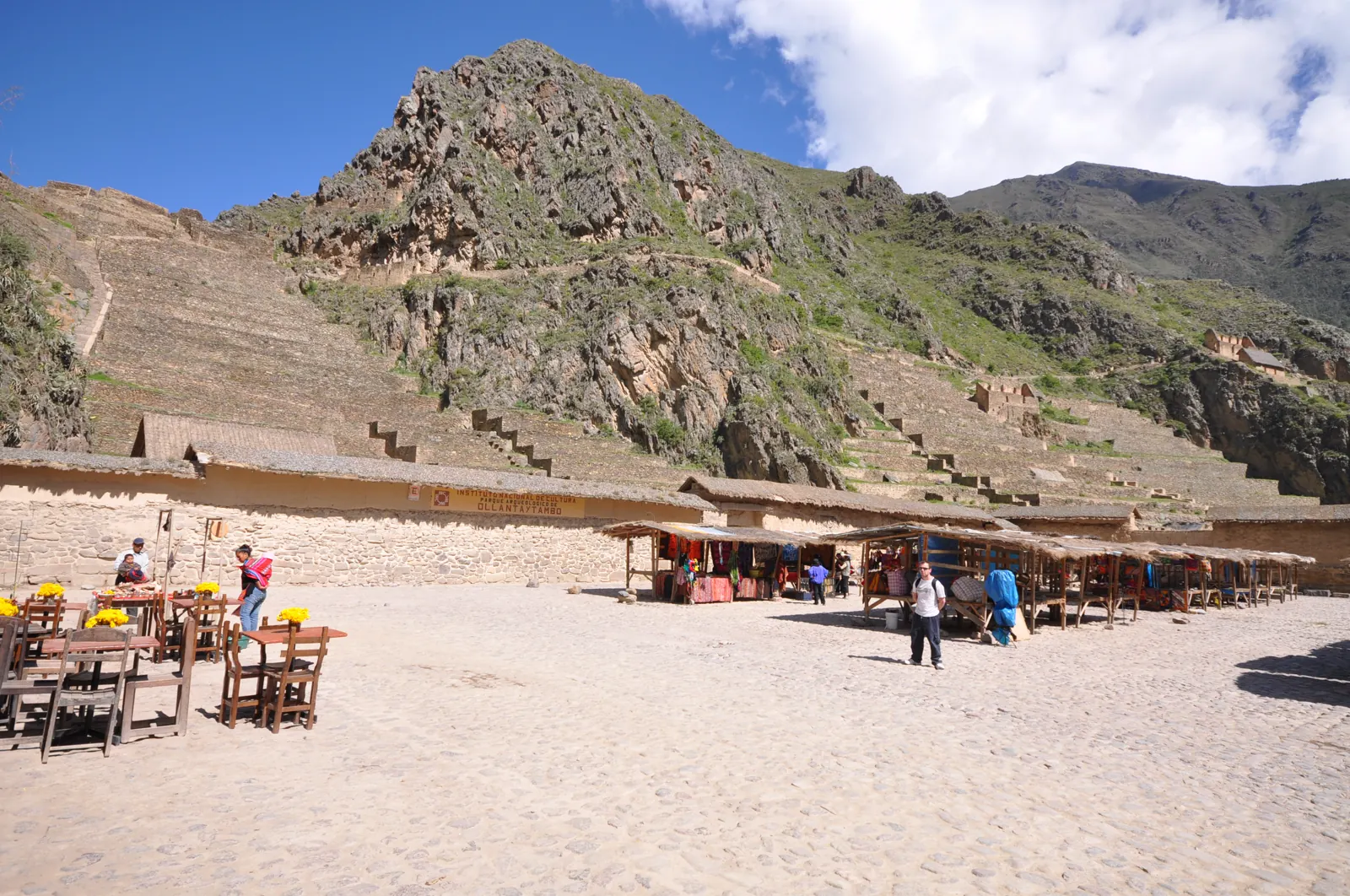
PeruRail does run services that start in Cusco: San Pedro, Poroy, or a bus from the city to a station farther down the valley and then the train. Inca Rail's Cusco option is the same shape, a transfer to Ollantaytambo included with the ticket. I use those when someone truly has one night in Cusco and the entry hour is late enough to survive the extra time. They are the exception.
PeruRail publishes the Ollantaytambo–Aguas Calientes ride at roughly an hour and a half to two hours, depending on the service. The live board is the one that counts on the morning you travel. From the town, a shuttle bus climbs to the citadel gate. Some people walk the steep path. I do not plan a timed entry around that walk unless the traveler already knows they want it. The valley day before the train is on the Sacred Valley page.
Match the train to the hour on the ticket
The citadel ticket and the train ticket are two different doors. In the trial that opened on 22 September 2026 and runs through 22 October, a Machu Picchu ticket on Tu Boleto has to be paid inside fifteen minutes, for one circuit and one entry hour. The Ministry may change that window afterward. I wrote the buying steps in the guide to the new ticket system. Read that before you open the clock. This page is about the train that has to agree with whatever hour you managed to buy.
A late train does not move the hour on the ticket. I have not seen the Ministry say that it does, so I do not plan as if it does.
The sequence I use:
- Choose the entry hour first, or the range of hours you would accept. Huayna Picchu is two hours only, 7 a.m. and 10 a.m. A classic Circuit 2 ticket can sit later in the day. The Machu Picchu page is the visit. The ticket guide is the board.
- Land in Aguas Calientes with a margin before that hour: the station, the bus queue, the climb to the gate.
- For a 6 a.m. or 7 a.m. gate, sleep in Machu Picchu Pueblo the night before. The first buses up the road are how dawn entries happen. A same-morning train from Ollantaytambo is the wrong tool for a summit at 7.
- For a mid-morning or afternoon gate, an Ollantaytambo departure can work the same day, if the published arrival still leaves that margin.
- Book the return after the visit, not against it. Circuit 2 can take the heart of a day. A train that leaves town while you are still on the terraces is a wasted seat in both directions.
If you want the guide, the hour, and the seats held as one private day, that is the private Machu Picchu tour. I book the seat when I book the citadel ticket, so the two times agree before you fly.
What you can carry
These are small trains in a narrow gorge. The allowance is a daypack, not the suitcase you brought from Lima.
On PeruRail's luggage page, Expedition, Vistadome, Vistadome Observatory, and Hiram Bingham include one backpack up to 8 kg (100 cm, height plus length plus width) or one carry-on up to 12 kg (115 cm). Larger bags can stay in station storage, or come aboard for a fee the company sets and changes. Read that page when you book, and use the fee printed there.
Inca Rail allows one piece of hand luggage, no more than 8 kg and 118 linear centimeters. There are no racks for suitcases. Custody is at the Ollantaytambo ticket office. Read their luggage policy before you leave a bag.
Leave the big bag at the hotel in Cusco or the Sacred Valley. Carry the layer you will want when the cloud drops on the saddle, the passport, the tickets saved where you can open them offline, and the medicine you cannot replace in town.
The single track can pause
On 2 October 2026, at about 1:25 in the afternoon, an Inca Rail train and a PeruRail train were in an incident near Pampacahua, on the Ollantaytambo–Machu Picchu section. PeruRail said the track concessionaire, Ferrocarril Transandino (FTSA), suspended traffic, and that no personal injuries had been reported. The same evening PeruRail said FTSA had authorized a progressive restart. The pause was measured in hours, not in a cancelled season. It was enough, if your gate was that afternoon, to miss the hour on the ticket.
That is the shape of a single-track gorge. One train that cannot move holds the trains behind it, from both companies. Rain from January through March can close the same line for a different reason.
One quieter change is already on the books. From 8 October through 31 December 2026, PeruRail said Expedition and Vistadome Observatory service 34 — the 15:20 from Machu Picchu — ends at Poroy for Cusco-bound passengers, then a bus to Wanchaq at about 19:45. Ollantaytambo passengers on that service can get off at Pachar. Other trains, PeruRail said, keep their regular schedule.
Both of those facts will age. The page that does not is the one I date each morning: https://travizperu.com/machu-picchu-train-status/. On the morning of 13 October 2026 it said trains were running between Ollantaytambo, Cusco, and Machu Picchu, with that Poroy afternoon return still in effect. Read it again the night before you travel. If a departure moves, I would rather change the plan in the valley than explain it on the platform.
How I book the day
Ticket hour and train seats belong in the same conversation. Board at Ollantaytambo unless the trip truly starts in Cusco. Buy the return with the outbound, check both passport names before anyone pays, and leave a margin in Aguas Calientes for the bus queue. Read the status page the day before. Check the fare on PeruRail or Inca Rail that same day. I will tell you which class I recommend. I will not invent what it costs.
If you would like me to hold the train against the ticket, tell me the dates, who is traveling, and whether the morning is a summit or the citadel itself. I am Francisco Arriz Barrantes, in Lima. TravizPeru is an APOTUR member, code AP030-11. WhatsApp is +51 982 521 128.
Tell me the dates and the hour on the ticket. I will match the train.
Sources, checked for this page on 13 October 2026:
- PeruRail schedules and frequencies — Ollantaytambo to Machu Picchu Pueblo, with journey times by service. The May–December 2026 timetable is the sheet that notes Hiram Bingham running every day except the last Sunday of the month.
- PeruRail live departures and arrivals — the board for the morning you travel. Fares are on the PeruRail booking site, and they change.
- PeruRail luggage policy — the 8 kg backpack or 12 kg carry-on allowance cited above.
- Inca Rail, compare train services — The Voyager, The 360°, The Prime, The First Class, and The Private. Book on incarail.com.
- Inca Rail luggage policy — one piece of hand luggage, 8 kg and 118 linear centimeters.
- PeruRail, 2 October 2026, 4:05 p.m. — the Pampacahua incident, traffic suspended by FTSA, no personal injuries reported. The 6:35 p.m. note says operations were resuming after FTSA's authorization.
- PeruRail, 7 October 2026 — service 34, the 15:20 from Machu Picchu, ending at Poroy for Cusco-bound passengers through 31 December 2026.
- TravizPeru train status, 13 October 2026 — the dated public note this guide points to. It is a summary, not a promise that your departure is unchanged.